The long way around
After my MFA I started leading writing retreats in Italy, Bali, and the Caribbean. Hosting these small curated groups reaffirmed my belief that nobody's stuck because they haven't found the right bestseller formula or whatever. Craft is important and new techniques can be helpful, but what we all really need is space and an empowering environment and someone who can help us get where we want to go. A novelist on one of those retreats had been stuck for two years. She finished her draft in a week.
Between retreats I built an off-grid home in Northern California by hand. I installed solar, stacked bricks, ran water lines, and dug into the hillside to build hobbit-style. I lived there for several years and learned a lot about how actually following through on a plan takes more work than you'd think at the outset.
When the pandemic grounded the retreats, I did what any reasonable author would do: I learned to code. I worked as a software engineer debugging Java microservices while my contemporaries baked sourdough and positioned for tenure. Then I eventually found my way into the secretive world of executive ghostwriting for technical founders.
I could try to position all of this as it was research or even very strategic. There's some truth to that. But really, Robert Bly writes about "ashes time," the years you spend tending someone else's fire, doing hard work that looks nothing like your calling, and then when you come into yourself you've transformed. The coding years were that.
Along the way: PR agency work, audiobook narration and genre fiction under other names, and a daily morning writing practice that I return no matter what else is going on.
Try the practice
Get five exercises delivered to your inbox over the next five days. It's a free introduction to the embodied writing practice, short enough to fit into your morning, deep enough to show you what's possible.
Unsubscribe anytime.
Writing is more than just a creative outlet
When I write and the rhythm gets going, at some point, the body organizes itself around the centralizing intent to create, and the thinking mind — what the Indian philosophical traditions call manas, the part that grips and manages and worries about whether the sentence is good — loosens its hold.
And what comes forward is something more like a witness. Not what people call mindfulness, but a felt quality of awareness that's inside you and inside the writing as it happens and is able to discern what's alive and what isn't.
I've learned that the thinking mind isn't really an insurmountable problem. Give yourself something steadier to rest on, like the body's rhythm as you write, or the forward momentum of language taking shape, and the mind becomes quiet. You don't need to wrestle it into submission. You can hold a question as you write and let your focus be really peripheral and receptive.
The traditions I study — tantra hatha yoga, meditative practice, Focusing, what the Desert Fathers meant by attention — help me see what's happening when the practice is working. And they help me weed the garden when it isn't. Most mornings it's a few minutes of noise before anything alive shows up.
The methods
These methods come from fifteen years of retreats, daily practice, and paying attention to what happens when someone sits down to write and needs to get somewhere.
Morning breathwork to connect the body before the pen moves. Silent breakfasts because the first words of the day should be internally-referenced. Long writing marathons less as an endurance test and more because something different happens at hour five that doesn't happen at minute twenty.
There are "sketching" techniques for writers who need structure but don't want an exhaustive outline to kill their sense of discovery. Bird's eye mode for seeing the whole shape of a project, and erotic distance for getting so close to your material that you merge with it. Modality shifts — handwriting to voice recording to walking — because the body thinks differently when it moves differently.
At retreats and events, there are evening reading circles that are neither workshops nor open mics. The author reads, the listeners respond from the felt level — not "I think the third paragraph needs work" but pointing to where a listening experience felt most alive. It's a form of critique that draws out the positive and shows the writer where to go.
Freewriting produces an overabundance of material. The sorting method is three piles — gold, compost, and cuts — and then building from the gold by re-seeing the work with fresh eyes and discovering what it actually wants to become, which is usually better than what you thought you were making.
The philosophy underneath it is about getting the creative impulse to lead and the critical impulse to serve. And the body is what holds the whole thing steady.
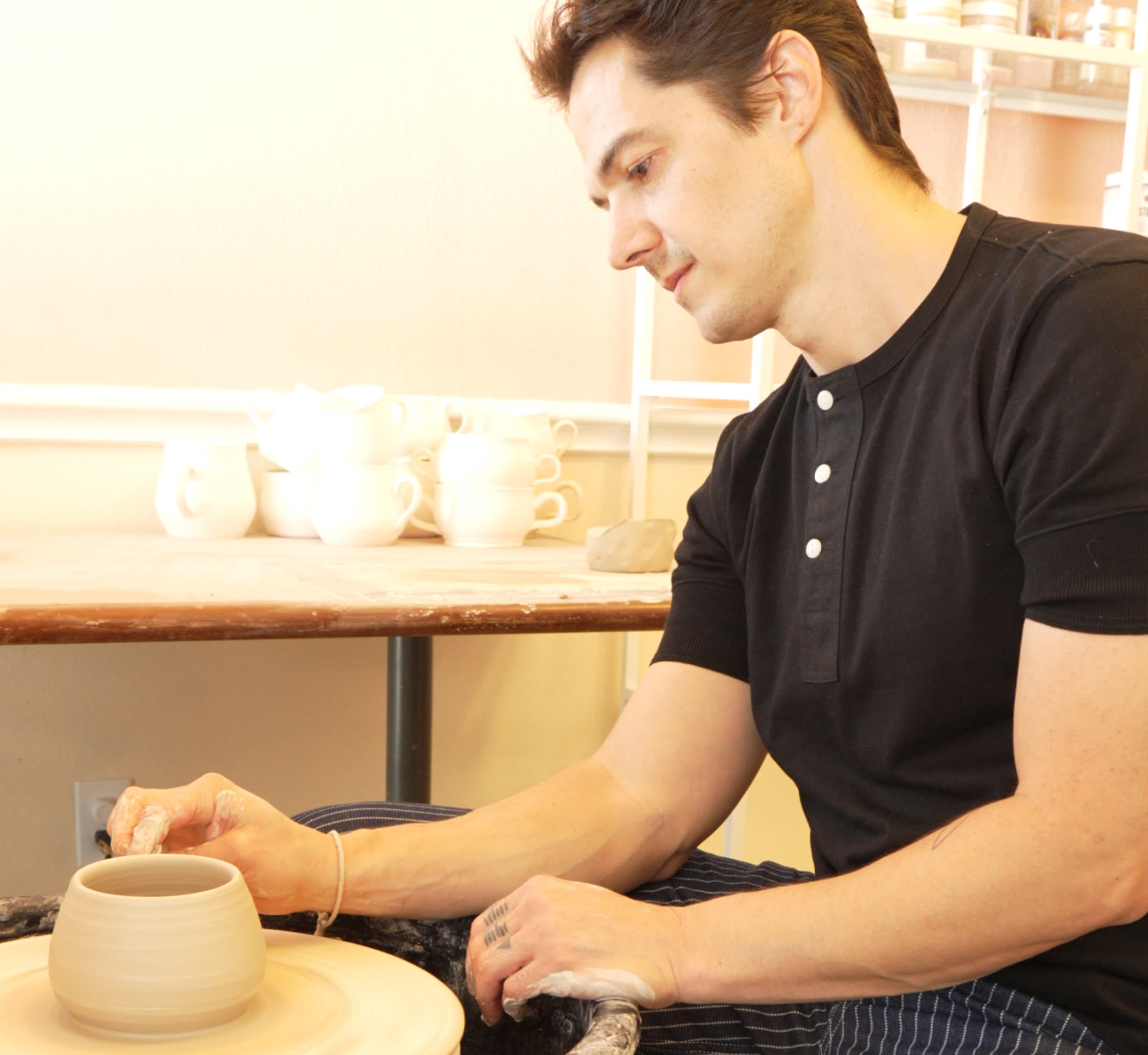
Making pottery. Austin, TX.
Shaped by
Literary: Walt Whitman, Denis Johnson, Russell Edson, Henri Michaux, Kurt Vonnegut, Thomas Pynchon, Cormac McCarthy
Visual: Marty Avrett, Ed Ruscha, Cy Twombly, David Shrigley
Philosophical: Keith Critchlow, Paul Reps, Shunryu Suzuki